
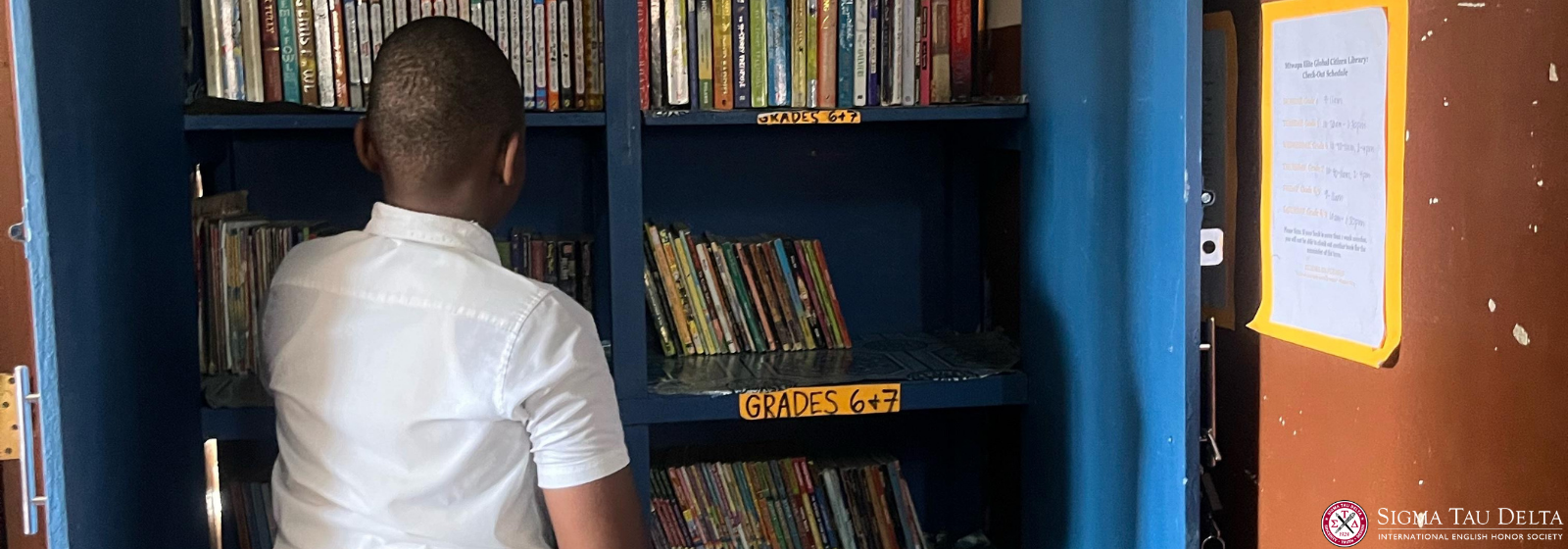
“But Madam Meg, where is the Explore Kenya book in the Exploring Countries series?” Lucky, a sixth grader at Mtwapa Elite Academy, asked me this question during our tea break one day. As a Fulbright English Teaching Assistant this past year, I lived and taught in Mtwapa, a semi-urban area just north of Mombasa, Kenya’s second-largest city. After about a month working at Mtwapa Elite, a bustling pre-primary through secondary school that enrolls around two thousand students, one of my colleagues approached me and asked what kinds of initiatives the school might be missing.
As an innovative educational environment that prioritizes debates, spelling bees, theatrical performances, and other co-curricular activities, I quickly noticed how Mtwapa Elite commits to their students’ growth. I also noticed that I didn’t see any students carrying around books. “Is there a school library?” I asked my colleague, and he led me to one of the staffrooms where a collection of about fifty books lay in a locked trunk, collecting dust. Without any means to expand the collection or resources to manage an active library, he told me, there wasn’t much they could do.
From that moment forward, brainstorming turned into fundraising, and fundraising turned into building. While my colleague coordinated with our supervisors at school to get our new “Global Citizenship Library” off the ground, I set rules and expectations for the students—and, of course, searched for books. As I shopped in the local Mombasa area, I realized that most of the children’s and young adult books being sold had been donated second-hand from foreign countries, mostly the US and the UK. When I loaded my cart with these titles, I thought of one of my favorite quotes by Rudine Sims Bishop, a multicultural children’s literature scholar. In 1990, she argued that texts should serve as “mirrors, windows, and sliding glass doors”: opportunities to see one’s own world reflected, see into a world different from one’s own, and even step into the world created by the author (Bishop, “Mirrors, Windows, and Sliding Glass Doors,” Perspectives: Choosing and Using Books for the Classroom, Vol. 6, no. 3, Summer 1990).
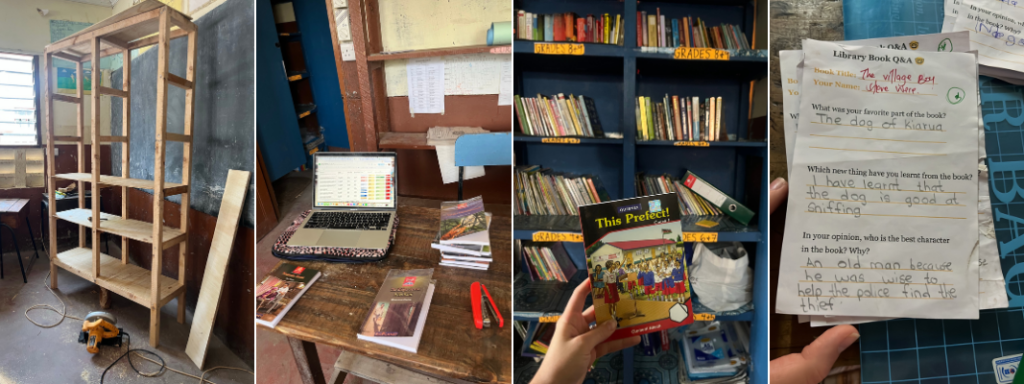
When Lucky asked me about the Explore Kenya book, I knew it was time to add more “mirrors” to our library. With Sigma Tau Delta’s Classroom Library Grant, more teachers at our school joined the librarian team, and we searched together for books that would be representative of our students’ lived experiences—while still being challenging, engaging reads. We coordinated with local Kenyan publishers to select titles like This Prefect! Is She Innocent? by Clement Akech and Lulu Karembo by Patrick Ngugi, written in Swahili. When word got out that these new books had hit the library shelves, the students scrambled to be the first in the check-out line at every tea break. We started a tradition of “mini handouts,” which prompted students to answer a few questions about their reading—and which simultaneously served as the perfect bookmarks! With the help of the Classroom Library Grant, we also purchased plastic book covers, which proved crucial to prevent the books from deteriorating in the rainy, dusty, indoor-outdoor environment of Mtwapa. At the end of the academic year in October, we accepted submissions from students to write their own stories and poetry, inspired by the library books they had read since last spring. With assistance from our Library Leaders, a group of seventh and eighth-graders who helped us with various library initiatives and tasks, we assembled the students’ submissions into a literary magazine.
As I re-read the magazine after returning home to the US, I realized that, by accessing “mirrors” in the library, our students had learned why their own stories matter—and why they deserve to be shared.

Meg Beuter
Classroom Library Grant Recipient, 2025
Mtwapa Elite Academy
Mtwapa, Kilifi County, Kenya
Sigma Tau Delta Classroom Library Grants
Sigma Tau Delta’s Classroom Library Grants are designed to enhance the Society’s goals of
- promoting interest in literature and language in the surrounding communities;
- fostering all aspects of the discipline of English, including literature, language, and writing; and
- serving society by fostering literacy.
The Classroom Library Grants are also intended to support our members who have entered the field of teaching and need material support to help achieve these goals through their work in the classroom by providing their students with a library in their own classrooms, especially where access to school or public libraries or to books in the home may be limited.
The Society will award up to five grants of $400 each per cycle to help student and alumni members of Sigma Tau Delta who are teachers of record in pre-school through twelfth-grade classrooms build a classroom library for their students. Applicants need not be recent college graduates or new teachers.
Criteria For Selection
In choosing recipients, evaluators will consider the following criteria:
- lack of economic and geographic access to books at your school, or another demonstrated need;
- the explanation of how the classroom library envisioned will support your goals in alignment with the Society’s goals; and
- supervisory endorsement of your classroom library project.
Deadline and Dates
Applications will be accepted through the AwardSpring platform June 22 through July July 13, 2026, 4:00 p.m. CT.
Sigma Tau Delta
Sigma Tau Delta, International English Honor Society, was founded in 1924 at Dakota Wesleyan University. The Society strives to
- Confer distinction for high achievement in English language and literature in undergraduate, graduate, and professional studies;
- Provide, through its local chapters, cultural stimulation on college campuses and promote interest in literature and the English language in surrounding communities;
- Foster all aspects of the discipline of English, including literature, language, and writing;
- Promote exemplary character and good fellowship among its members;
- Exhibit high standards of academic excellence; and
- Serve society by fostering literacy.
With over 900 active chapters located in the United States and abroad, there are more than 1,000 Faculty Advisors, and approximately 9,000 members inducted annually.
Sigma Tau Delta also recognizes the accomplishments of professional writers who have contributed to the fields of language and literature.

