

Is there a point to a Master of Fine Arts degree in Creative Writing in this day and age? I’d like to think that enough people recognize the absurdity of the present, but even if that were so I can’t say it’s a comfort. Being in the know isn’t enough anymore. The point of informing is so action can be taken. If there’s no action, we might as well have never been informed. And that’s what I fear for us future writers: that we as readers have become like students in a classroom with a broken AC—so burnt out that when someone gives the wrong answer, we don’t bother to correct them. Worse, I fear we will stop writing altogether, not seeing the point.
There is a point, though. Stories are the reflection of our wants, our sorrows, our dreams and battles, played out by the heroes and villains we birthed just as significantly as our children. A person’s experiences are as unique as a fingerprint. Not one is the same as another, and yet at the same time there’s familiarity. We see ourselves in other’s stories. It’s how we connect on a deeper level. It’s why our world will always need stories. Especially when those stories are being censored. Book banning and censorship isn’t new. Many literary classics have been raked over the coals, vilified, and removed from shelves. What’s rather startling, however, is the fact it’s still happening today. Society ought to know by now that the practice doesn’t work, especially when it comes to contemporary fiction. At its heart, contemporary fiction is introspective connection—it’s where the deep questions within ourselves are brought to the surface and reflected back to us.
It’s no coincidence that the current trends in the contemporary genre are that of the YA, LGBTQ+ contemporary romance, and contemporary-speculative subgenres, with an emphasis on “personal narratives rather than sweeping, plot-heavy epics.” (Thriller Magazine). These subgenres ask their protagonists, and in turn us, the reader, to confront a battle within, in the familiar setting of now. None of these genres are new. After all, what are they but peeks behind the romantic curtain? Warnings of a world where unchecked scientific advancements lead to our downfall? Voices from the underage demographic most poised to effect change? And commentary on the present, in mind and heart?
We’ve seen what book banning eventually leads to when the ends justify the means: book pyres. Alternative facts. Propaganda. For most, its success is a signal to concede. I argue the opposite: it’s an invitation to challenge. To reinvent and reconvey. To re-inspire and show, not tell. To enter through the back door. And how do we do this? How do we show our truth, our point of view in a way they will see? In a medium they aren’t expecting. In the stories we craft, and by fighting for those stories to be heard. By doing what those who want to ban these books don’t want: for us to read and talk about them. Because doing so acknowledges their existence, acknowledges complex answers and circumstances that can’t be explained away with a simple yes or no. Characters and themes, arcs and climaxes, these craft elements are more than the tools in a writer’s toolkit. And stories are more than entertaining breaks from reality: they’re truth, in essence, reborn.
An MFA program isn’t a formulaic system of memorizing facts and regurgitating them in simplified form. It’s a practice in doing what we’ve been conditioned to deny ourselves for the majority of our lives: to look inward and express; to create and share our truths. An MFA in creative writing won’t allow you to diagnose cancer in a patient. Nor will it qualify you to identify prehistoric bones or properly dissect a crime scene. But it just might be the answer to a world being poisoned by cognitive dissonance and fear. To be a writer is to be a vessel for truth, and right now, truth is the only antidote.
Cassandra Manuel
Alpha Phi Beta Chapter
Southern New Hampshire University-Online
2025 Banned Books Week Social Media Contest
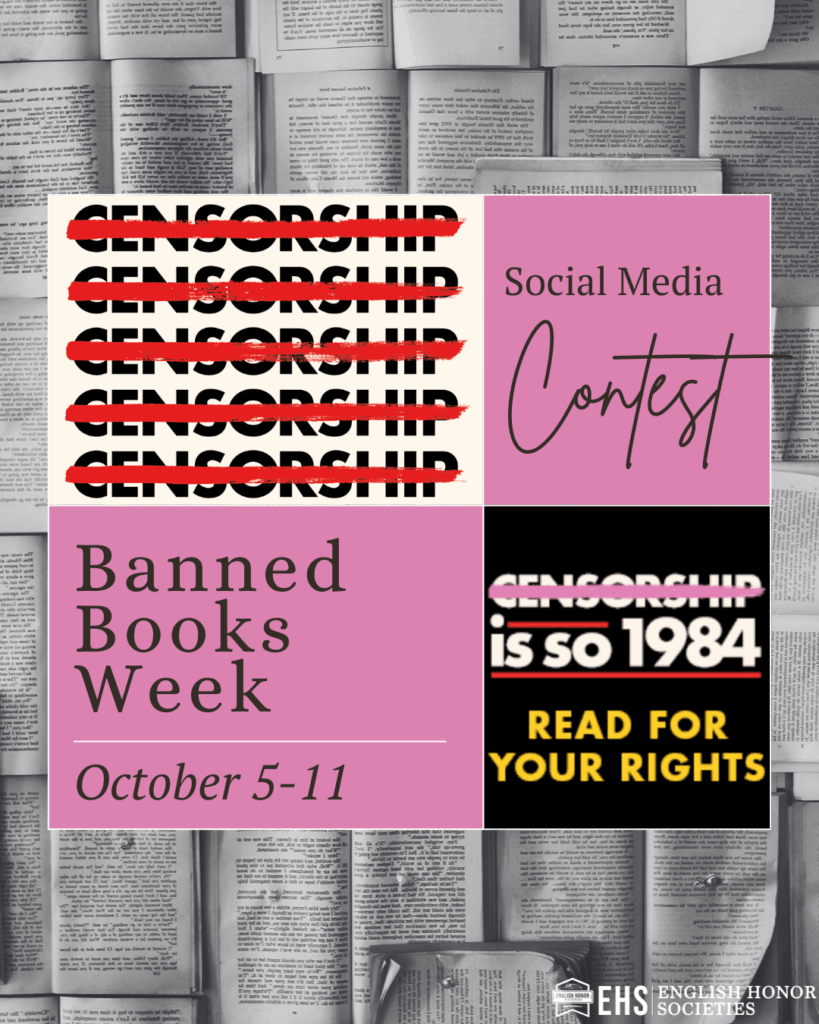
In celebration of Banned Books Week (October 5 – 11, 2025), Sigma Tau Delta, NEHS, and the ELA Honor Society are teaming up to host the tenth annual Banned Books Week social media contest. To participate you must tag us in a post on any of the following social media accounts:
- Sigma Tau Delta Facebook
- Sigma Tau Delta Twitter (@EnglishCon)
- English Honor Societies Instagram (@EnglishMatters)
What to do in Your Post:
Books are banned for a variety of reasons. Take your own original photo of your favorite banned book and share with us (on one social media platform) one of the reasons it has been contested. If you wish to post on a second platform, please choose a second banned book to post about.
The contest will run October 5 – 11, 2025. Everyone who participates during this time frame will be entered in a drawing to win one of three $25 Bookshop.org gift cards. A $50 Bookshop.org gift card will also be awarded for the best overall post. Select submissions will be shared across our social media platforms.
Resources
Beyond Banned Books Week: What Can We ACTUALLY DO to Protect Literary Freedom?
I’m With the Banned: The Whys and Hows of Banned Books Week
Troubling Trends in Book Censorship
Milton and Paradise Reimagined: Book Censorship Today
George Orwell and Recent Censorship
Don’t Burn the Books
How Old is Holden Caulfield?: Censoring a Teenage Narrator in an Adult Book from Teenage Eyes
Why Books Depicting Violence are Important
Banned Books: Stand Up for What Moves You
Banned Books: Symbols of Positive Ideological Shifts
What Intellectual Freedom Is—And Why and How We Ought to Preserve It
More from Footnotes: September 30, 2025
Submit to the 2026 Convention Webinar
New Orleans Writing Contest Submissions
Book Club Kits
Cambridge Undergraduate Summer Program

