
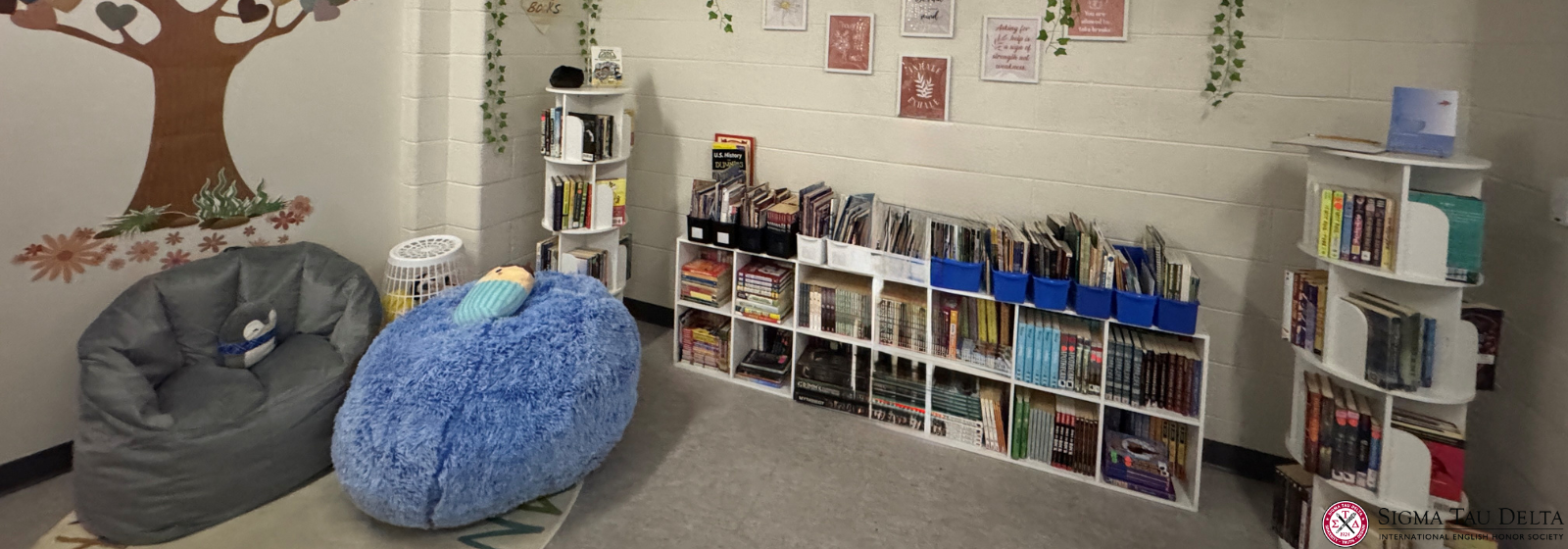
When I began my first year teaching seventh-grade English Language Arts, I wanted my students to encounter books that felt alive—stories they could see themselves in, titles that sparked curiosity, and characters who echoed parts of their own lives. That’s a tall order in a middle school classroom, especially when resources are limited. Sigma Tau Delta’s Classroom Library Grant gave me the chance to turn that goal into something tangible: a library that my students not only use, but claim as their own.
The books I was able to purchase have already changed the way reading looks in my classroom. Many gravitate toward The First Rule of Punk by Celia C. Pérez, Half Moon Summer by Elaine Vickers, Kareem Between by Shifa Saltagi Safadi, and They Call Me Güero by David Bowles. These titles speak directly to my students’ cultural and linguistic identities. One student told me, “This character reminds me of my cousin,” while another explained, “I feel like this story could be about me.” In middle school, those kinds of connections matter—they validate who students are and show them that literature is not distant or abstract, but personal.
At the same time, popular series like The Hunger Games, Percy Jackson and the Olympians, and The Summer I Turned Pretty have brought in a different kind of energy. Students who previously said they didn’t enjoy reading now check out these books because they recognize the covers from streaming services or movie posters. These familiar stories act like a bridge: once they’ve stepped into reading through something recognizable, they’re more open to exploring other titles on the shelves.
Every Friday, the first twenty minutes of class are devoted to independent reading. Initially, I expected that some students would treat this as “break time,” but the opposite has been true. The hardest part is getting them to put the books down when the timer goes off. Several students take their books home and come back asking for another before the next Friday arrives. They trade recommendations with each other and even keep informal lists of what they want to read next. Watching this quiet network of readers emerge has been a reminder that students will invest in books when the books matter to them.
These library books have also provided something my students didn’t know they needed: relief. Our curriculum texts are challenging and analytical by design. They push students to annotate, debate, and interpret at a high level. But having the option to read books purely for enjoyment has balanced that rigor. Many students have said it feels good to “just read” without being asked to dissect every sentence. Ironically, that freedom has made them more willing to take on the harder work our required texts demand.

I am especially grateful for the books I was able to purchase in Spanish. For my bilingual students, being able to choose a book in the language they use at home has been affirming. Several have explained that it makes them feel more confident as readers overall, and it has encouraged them to pick up books more consistently.
The Classroom Library Grant did more than put new titles on shelves—it gave my students access, agency, and excitement. They’re no longer reading only because it’s assigned; they’re reading because they want to. That shift is invaluable, and it’s one I know will ripple outward into their lives long after they leave my classroom.

Venus Viernes
Classroom Library Grant Recipient, 2025
Indian Trail Junior High School
Addison School District 4, IL
Sigma Tau Delta Classroom Library Grants
Sigma Tau Delta’s Classroom Library Grants are designed to enhance the Society’s goals of
- promoting interest in literature and language in the surrounding communities;
- fostering all aspects of the discipline of English, including literature, language, and writing; and
- serving society by fostering literacy.
The Classroom Library Grants are also intended to support our members who have entered the field of teaching and need material support to help achieve these goals through their work in the classroom by providing their students with a library in their own classrooms, especially where access to school or public libraries or to books in the home may be limited.
The Society will award up to five grants of $400 each per cycle to help student and alumni members of Sigma Tau Delta who are teachers of record in pre-school through twelfth-grade classrooms build a classroom library for their students. Applicants need not be recent college graduates or new teachers.
Criteria For Selection
In choosing recipients, evaluators will consider the following criteria:
- lack of economic and geographic access to books at your school, or another demonstrated need;
- the explanation of how the classroom library envisioned will support your goals in alignment with the Society’s goals; and
- supervisory endorsement of your classroom library project.
Deadline and Dates
Applications will be accepted through the AwardSpring platform June 22 through July 13, 2026, 4:00 p.m. CT.
Sigma Tau Delta
Sigma Tau Delta, International English Honor Society, was founded in 1924 at Dakota Wesleyan University. The Society strives to
- Confer distinction for high achievement in English language and literature in undergraduate, graduate, and professional studies;
- Provide, through its local chapters, cultural stimulation on college campuses and promote interest in literature and the English language in surrounding communities;
- Foster all aspects of the discipline of English, including literature, language, and writing;
- Promote exemplary character and good fellowship among its members;
- Exhibit high standards of academic excellence; and
- Serve society by fostering literacy.
With over 900 active chapters located in the United States and abroad, there are more than 1,000 Faculty Advisors, and approximately 9,000 members inducted annually.
Sigma Tau Delta also recognizes the accomplishments of professional writers who have contributed to the fields of language and literature.

