
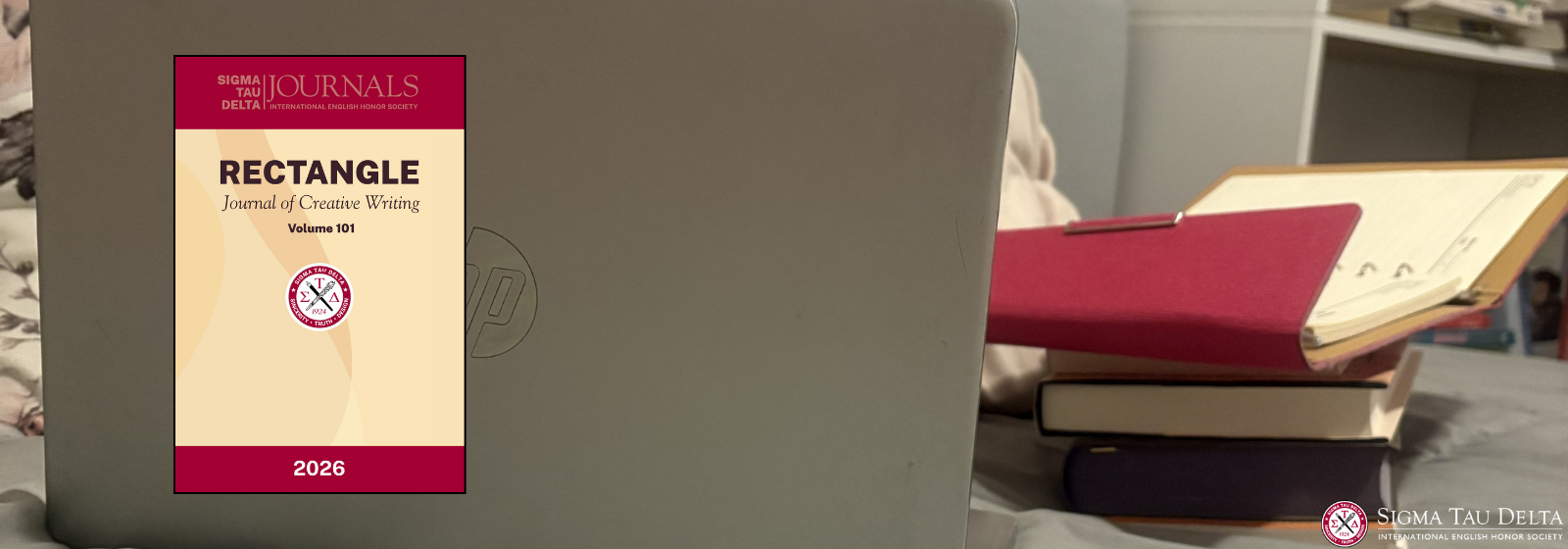
What an honor it is to have the first piece of creative nonfiction I wrote in my first year as an undergraduate be named the Elizabeth Holtze Best Personal or Informal Essay in the 2026 edition of the Sigma Tau Delta Rectangle. If anything, though, it is a testament to the power of revision.
When I first started as a creative writing undergraduate, I didn’t even know creative nonfiction was a genre. I’ve found this to be true with many people who ask me what I like to write and then think it is scientific nonfiction about lions or carbon dating or whatever else I would never be able to write about without doing extensive research. It’s awkward to tell them that I write about my own life because that leads to more questions about what it is exactly that I write. While I often write about moments in my life that felt overwhelming or traumatic—including my experience growing up in a high-demand religion, as seen in the piece I submitted to the Rectangle called “Divine Nature”—I am always reminded of the beauty that comes from reading about others’ experiences, large or small, extreme or ordinary. There is beauty in human life, and it is a privilege to get to document that in some way.
Last year, my second year as an undergraduate, I joined the Rho Tau Chapter of Sigma Tau Delta at the encouragement of a Faculty Advisor to participate in the year-long events and join a Roundtable at the annual convention. I thought it would be a fun opportunity, but actually being able to attend the 2025 Convention was, at risk of sounding corny, a life-changing experience. It was worthwhile to see so many people unite over their love of English, writing, reading, and teaching. It reinvigorated my passion for it, taught me helpful professional skills, and showcased the importance of what I was doing when studying creative writing. Language, communication, and appreciation of art brings people together.
The convention also opened up new opportunities. I was able to gain information on potential grants and internships to apply for, and I also learned about the Rectangle. I knew it would be an absolute privilege to see my work in this international journal, and I turned back to that first piece of creative nonfiction I wrote—the one that showed me exactly what I have been always wanting to write, always passionate about communicating. From there, I revised, hoping the piece would get to the point I wanted it to be if it were to appear in the journal.
Getting the email that my piece was accepted was surprising and exciting. Getting the email that I’d won an award was a moment I will never forget, one that involved me frantically calling my parents to let them know. While I am honored and proud to receive it, beyond that, the fact that there are journals publishing student work and providing awards for works of writing brings me so much hope and joy. As long as we continue to see the value in each others’ works, others will too. At a time when it feels a bit scary to be going into a field that largely appears undervalued, it is so helpful to remember that its value is still seen. Perhaps more quietly, writing is still valued, appreciated, and recognized.
Ella Stott
Elizabeth Holtze Creative Nonfiction Award Recipient for “Divine Nature,” published in the 2026 Sigma Tau Delta Rectangle (pp. 23)
Rho Tau Chapter
Utah State University, Logan, UT
Journal Submissions
Annually, Sigma Tau Delta publishes two journals to distribute the best writing and criticism produced by active members of the Society.
Undergraduate and graduate students who are enrolled through the spring semester and are members of active Sigma Tau Delta chapters are invited to submit their work to the Sigma Tau Delta Review and the Sigma Tau Delta Rectangle. Chapter Advisors, faculty members, alumni, and honorary members are not eligible to submit.
Sigma Tau Delta Rectangle (founded in 1931) is an annual journal of creative writing—fiction, nonfiction, and poetry. Submissions should not exceed 2,500 words. Members whose works are published also may participate in a reading at the annual Sigma Tau Delta convention.
Sigma Tau Delta Review (founded in 2005) is an annual journal that publishes critical essays on literature and rhetoric/composition and essays devoted to pedagogical topics. Submissions should not exceed 3,000 words, excluding notes and works cited. Critical essays follow the style guidelines as defined in the MLA Handbook for Writers of Research Papers (latest edition).
Claim your copies of the 2026 Sigma Tau Delta Rectangle and Sigma Tau Delta Review to read samples of the quality of work habitually accepted for publication.
Submission Guidelines
Learn more about guidelines for submissions including eligibility, formatting, and acceptance notification.
View: Submission Guidelines
Submission Instructions
Find out what application materials you must have prepared when you begin the submission process.
View: Submission Instructions
Submission FAQs
Learn tips about successful journal submissions as well as specifics for each journal and information about the publication in general.
View: Submission FAQs
Publication Archive
View: Current and Past Publications
Publication and Awards
These two journals are refereed, with faculty reviewers from around the world selecting works to be published. The journals have had illustrious head judges including Jane Brox, Henri Cole, Jim Daniels, W. D. Earhardt, CJ Hribal, Kyoko Mori, Lisa Russ Spaar, and Mako Yoshikawa.
The Sigma Tau Delta journals are catalogued with the Library of Congress.
The best writings in each category are acknowledged with five awards (each $500):
- E. Nelson James Poetry Award
- Eleanor B. North Poetry Award
- Frederic Fadner Critical Essay Award
- Herbert L. Hughes Short Story Award
- Elizabeth Holtze Creative Nonfiction Award
Award Winners
View: Past Award Winners
How to Apply & Deadlines
Submissions for the Sigma Tau Delta journals are accepted through AwardSpring during the Spring Awards Cycle, which is open March 16 – April 13, 2026, 4 p.m. CT.
Past Journal Submission Blogs
Check out blog posts submitted by former Sigma Tau Delta student members who have been published in the Sigma Tau Delta journals to gain inspiration for your journal submission.
View: Past Journal Submission Blogs
Sigma Tau Delta
Sigma Tau Delta, International English Honor Society, was founded in 1924 at Dakota Wesleyan University. The Society strives to
- Confer distinction for high achievement in English language and literature in undergraduate, graduate, and professional studies;
- Provide, through its local chapters, cultural stimulation on college campuses and promote interest in literature and the English language in surrounding communities;
- Foster all aspects of the discipline of English, including literature, language, and writing;
- Promote exemplary character and good fellowship among its members;
- Exhibit high standards of academic excellence; and
- Serve society by fostering literacy.
With over 900 active chapters located in the United States and abroad, there are more than 1,000 Faculty Advisors, and approximately 9,000 members inducted annually.
Sigma Tau Delta also recognizes the accomplishments of professional writers who have contributed to the fields of language and literature.

