
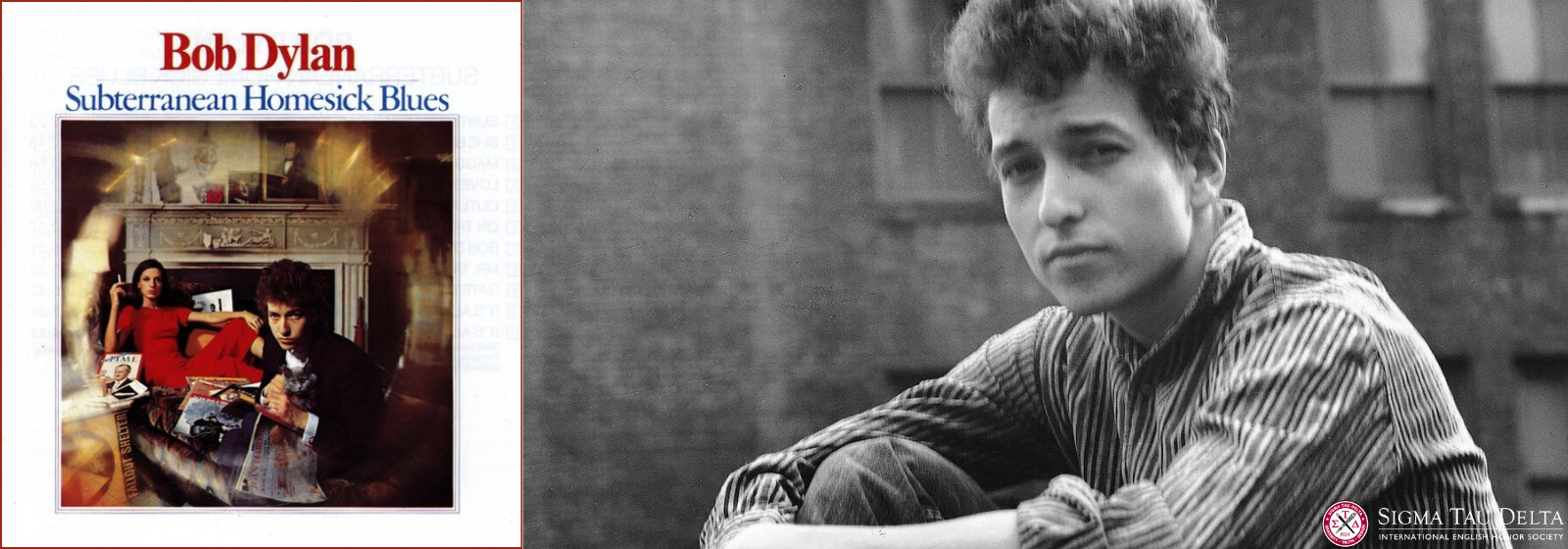
By the mid-1960s, much of mainstream rock began to lose its edge, becoming commercially driven when famous beatnik and musician Bob Dylan decides to break into a more sonically progressive jailhouse rock/blue grass genre. However, Dylan is considered far from conventional mainstream rock at this point. Due to his early roots in folk, he remains the earthy contrarian often calling out the healthcare system and industrial complex. At just 23 years old, Dylan writes “Subterranean Homesick Blues” (1965) where he captures the old rebellious spirit of 1950s protest rock while speaking metaphorically to his younger following.
Using a metaphorical analysis and a neo-Aristotelian critique, this essay specifically focuses on Dylan’s lyrical messaging and language choice buried beneath his own societal critique among verses 1 and 4 of “Subterranean Homesick Blues.” Within these few stanzas, the imagery and language choice calls for a metaphorical critique to fully understand both the subtleties, and more pervasive messaging to his audience. This critique does not discuss the sonic or visual aspects of the song or accompanying music video but rather lexical writing; in efforts to demonstrate that lyrics are not static without instruments, but intentionally and rhetorically curated to wake up a generation.
Dylan’s earlier folk music pushes back against mainstream sex, drugs, and rock ‘n’ roll, offering opposing commentary to the changing times. He finds a way to blend his folk sensibility with rock’s upbeat and rhythmic energy. The song’s title nods to the Beat Generation and its underground culture in those dusty New York City bars. Poet Allen Ginsberg, and Jack Kerouac’s 1958 novel The Subterraneans, portray the raw, bohemian lives of young ballad artists, using the term ‘subterranean’ to describe the kids of Greenwich Village, who often hosted sit ins and peaceful protests much like Dylan himself. The term homesick commonly refers to a child or young person nostalgic for their childhood and better times in the face of growing up, changing times and civil unrest. This helps to situate audience members in a youthful frame of reference, which would have made up most of Dylan’s following at that time.
Bob Dylan begins the song with how he cannot help but sit and think about the government and their social order while kids are experimenting with drugs, both equally learning to find their own place in this society. He urges the youth to stay vigilant and abstain from adapting to the popular or social norms. He paints a picture of someone who plays by the rules, doing everything expected, from relationships and keeping partners happy, to honest work in a day job. But Dylan presents this scenario in a way that feels almost second person, like watching through the eyes of the subject or experiencing it from a camera. Yet, despite following every rule, said person still faces the disillusionment of investing in higher education only to end up in a mundane job. When Dylan notes “they keep it all hid,” it’s not just the rules that remain concealed, but the harsh reality of how the system truly operates (Parker). Here he is talking to people his age and younger. Kids in their twenties, trying to make a go of it while searching for peace and freedom. He dictates this like a commencement speech to the youth saying never commit to the path laid out for you blindly without fully grasping all its limitations.
“Subterranean Homesick Blues” (1965)
by Bob Dylan
Lyrics from verses 1 & 4:
“Johnny’s in the basement, mixin’ up the medicine
I’m on the pavement, thinkin’ about the government
The man in a trench coat, badge out, laid off
Says he’s got a bad cough wants to get it paid off
Look out, kid, it’s somethin’ you did
God knows when, but you’re doin’ it again
You better duck down the alleyway, looking for a new friend
The man in the coon-skin cap in a big pen
Wants eleven dollar bills, you only got ten”
“Learn to dance, get dressed, get blessed, try to be a success
Please her, please him, buy gifts, don’t steal, don’t lift
Twenty years of schoolin’ and they put you on the day shift
Look out, kid, they keep it all hid
Better jump down a manhole, light yourself a candle
Don’t wear sandals, try to avoid the scandals
Don’t want to be a bum, you better chew gum
The pump don’t work ’cause the vandals took the handles”
Dylan’s ultimate advice is to reject that predetermined path. He urges retreat into the underground like his kind, “jump down a manhole” to find your own way, even if it means lighting the path yourself with a candle; “don’t wear sandals” is a means to avoiding standing out in ways that mark you as unserious or out of place since appearance and conformity shape whether society listens or dismisses you (Parker). He is poking fun at the seriousness of the business world. Adopting fashion and commercial slogans are often the price of acceptance in this world.
The lyrical imagery in, “the pump don’t work cause the vandals took the handle” seems to be economic metaphor. In times of hardship, governments often stimulate the economy, by injecting resources like tax credits or economic relief (pandemic stimulus checks) to promote spending and spur growth, also known as priming the pump. But when social order breaks down, even those systems fail. Vandals, literal or systemic, take advantage and sabotage the very tools meant to offer relief, as seen so many times in the past 50 years. This reflects moments like the Watts riots of 1965 in Los Angeles after a couple of arrests. Forty million dollars in damage struck a community already suffering from economic and racial injustice, compounding the very problems protestors sought to expose.
Though this is a lyrical critique it is important to note that when one listens to Dylan’s music, sonically, he has not been deemed as one of the best vocalists of that time. His vocal tone is flat, nasal, stoic and quick like a mumble rapper. Often times he even appears to be intentionally detached, stripping away sentimentality and forcing focus on content. But this is why the lyrics are intentionally to be deliberated as poetry.
Whether reading digitally or on a piece of paper, the lexicality does not fall flat. The straight forwardness in his writing mimics a street preacher, or even a conspiracy theorist warning us about the aliens and flying saucers in the sky. The repetition of imperatives “don’t follow leaders . . . watch the parking meters” creates a juxtaposition of sobriety mixed with mundanity that reinforces the absurdity and emptiness of modern life. He tries to identify with the generation he is speaking to by using common colloquialisms of that time while also writing in second person to his audience. Like a letter, or perhaps a call to action. Dylan’s rapid-fire delivery, coupled with the litany of warnings, creates anxiety and unease. The audience feels bombarded, much like the citizen trapped in modern society. He incorporates moments of humor or absurdity, “you don’t need a weatherman to know which way the wind blows,” providing comic relief but ultimately reinforcing the bleak tone.
The song is expertly timed. For Dylan and his peers, 1965 posed a time of civil unrest, generational questioning, and looming escalation in Vietnam. The kairotic moment, offers a critique that speaks directly to the youthful sense of government entrapment and the need for freedom. By this time Dylan’s street credibility as a truth telling folk icon had been established for three years (Wilkowski). So rather than using logical argumentation, he relies on accumulation and associative logic from analogies. Each verse presents scenario after scenario, rule after rule, forming a logical web that illustrates the overwhelming, contradictory nature of societal expectations. The concluding economic metaphor about the broken pump, and “twenty years of schoolin’ and they put you on the day shift,” functions as the most explicit logical image of systemic failure and the proverbial rat wheel of America.
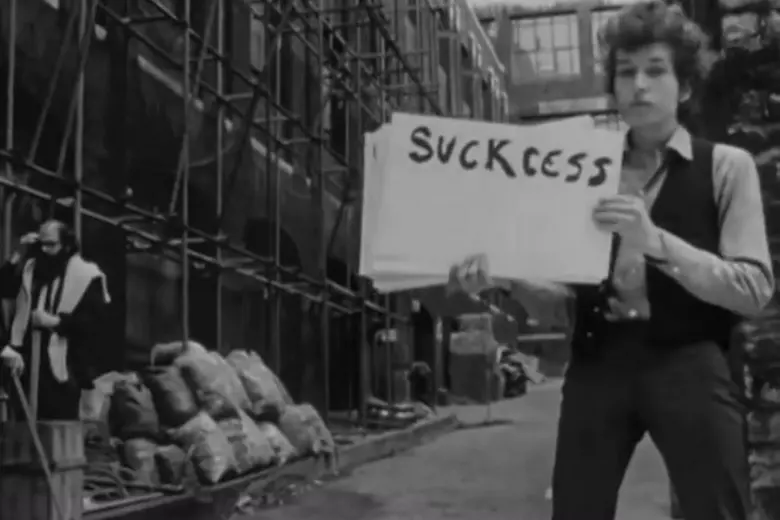
Dylan’s intended response was to jolt his audience into recognizing the absurdity and constriction of societal rules and expectations. His lyrics aim to provoke skepticism about authority figures like teachers, Madison Square Garden advertisements, 9 to 5’s, law enforcement, and even band wagoning fans. “Bob clearly shared an admiration for the values of the common man, as a means to supplement or correct the many shortcomings of contemporary mass culture. He and folk icon Alan Lomax, both agreed that important values were those that were real, basic, fundamental in a way that superficial Madison Avenue advertising was not. They both opposed the accumulation of material things” (Dunlap 558).
The song’s cultural references resonated with a generation questioning the status quo. Lines like “You don’t need a weatherman to know which way the wind blows” became catchphrases, even inspiring the radical leftist group The Weather Underground (Parker). Looking at other songs such as “The Death of Emmett Till and Who Killed Davey Moore?” Dylan told a story by paralleling the ideals of civil disobedience espoused by Gandhi and Martin Luther King Jr., urging moral introspection over direct political mobilization (Dunlap 560).
Similarly, “The Lonesome Death of Hattie Carroll” actively resisted possible passive liberal sympathies by directing his audience not to cry for the tragic murder of a maid until the real injustice is revealed: the privileged murderer’s mere six-month sentence (Dunlap 561). He scorns a resorted intellectual and performative response, arguing that predictable liberal empathy is hollow if it fails to inspire real engagement. Through this rhetorical strategy, Dylan forced his own audience to acknowledge their complicity.
Dylan’s lyrical writing is deliberate and transformative in its ability to serve as a subtle metaphor using catchy 60s slang and vernacular to create a larger pervasive rhetorical message. His songs, often categorized as “rhetorical” protest music (Denisoff 179; Dunlap 559), went beyond simple calls to action, instead compelling listeners to engage in deep self-reflection.
Using the metaphorical analysis and neo-Aristotelian approach to critique the rhetorical situation of Dylan’s poetic work, the metaphor, imagery, and lexicons were interpreted to demonstrate rhetorical impact. “Subterranean Homesick Blues” is among Bob Dylan’s robust repertoire of music that is carefully and rhetorically curated, painting a bigger picture for a large generation of listeners. More than passive listening or emotional response, his writing demanded active awareness for active change. This would set in motion a moral reckoning within the genre of protest rock that would shape the political and cultural movements of the 1960s and beyond (from the beatniks to the hippies).
Works Cited
Corbett, E. P. “The Usefulness of Classical Rhetoric.” College Composition and Communication, vol. 14, no. 3, 1963, pp. 162–64.
Dunlap, J. “Through the Eyes of Tom Joad: Patterns of American Idealism, Bob Dylan, and the Folk Protest Movement.” Popular Music and Society, vol. 29, no. 5, 2006, pp. 549-73, 637.
Parker, Chris. “The Story and Meaning Behind ‘Subterranean Homesick Blues’ by Bob Dylan.” American Songwriter, 18 Feb. 2024, https://americansongwriter.com/the-story-and-meaning-behind-subterranean-homesick-blues-by-bob-dylan/.
Wilkowski, Colleen. “Use of Rhetoric in 1960’s Protest Music: A Case Study of Bob Dylan’s Music.” Honors Program Theses, Paper 17, 2015, https://digitalcommons.library.umaine.edu/honors/17.
https://kinginstitute.stanford.edu/watts-rebellion-los-angeles
https://ultimateclassicrock.com/bob-dylan-subterranean-homesick-blues-video/

Rachel Taylor
Alpha Nu Iota Chapter
Nova Southeastern University
Sigma Tau Delta
Sigma Tau Delta, International English Honor Society, was founded in 1924 at Dakota Wesleyan University. The Society strives to
- Confer distinction for high achievement in English language and literature in undergraduate, graduate, and professional studies;
- Provide, through its local chapters, cultural stimulation on college campuses and promote interest in literature and the English language in surrounding communities;
- Foster all aspects of the discipline of English, including literature, language, and writing;
- Promote exemplary character and good fellowship among its members;
- Exhibit high standards of academic excellence; and
- Serve society by fostering literacy.
With over 900 active chapters located in the United States and abroad, there are more than 1,000 Faculty Advisors, and approximately 9,000 members inducted annually.
Sigma Tau Delta also recognizes the accomplishments of professional writers who have contributed to the fields of language and literature.

