

Hannah Pajtis reporting during inauguration weekend at the Washington DC People’s March for The Hawk Newspaper, the independent student-run newspaper of Saint Joseph’s University.
I’ve adored writing as long as I can remember. It’s my first love and most consuming passion. Many of my early childhood moments consisted of sporadic scribbling, a core memory being writing and illustrating a homemade children’s book for my little brother. I’ve always known deep down it’s my purpose. But throughout high school, specifically when discerning my career path, I lost sight of this vision. The repeated mantras of “you won’t make any money pursuing English” and “what else can you do with an English degree besides teach?” were ever-present in my mind. Worried about my career trajectory and convinced I might not be half good enough for the major anyway, I declared a major in communications. I resolved that I had no choice but to keep writing as a lifetime “side hustle.”
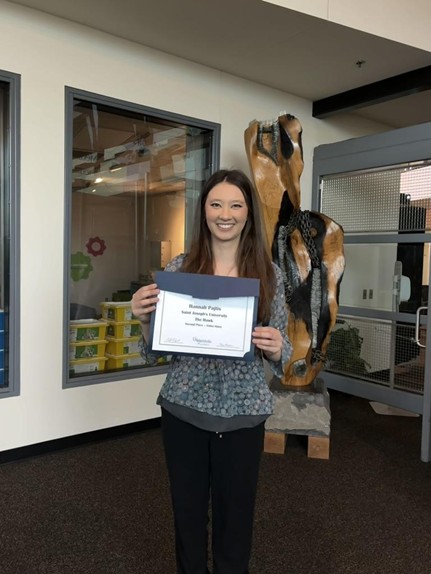
For the record, I love communications and kept the major. But as a rising senior, I can’t imagine my college career without stumbling headfirst into journalism and declaring a second major in English. During the second semester of my first year, I took a news reporting class because it was a prerequisite to writing for my university’s student newspaper, The Hawk. That class single-handedly changed the trajectory of my life. I applied to be The Hawk‘s news editor in my sophomore year and from that point, there was no looking back.
Journalism threw me headfirst out of my comfort zone. In a field where you’re constantly forced to talk to strangers, this seems inevitable. But my small student newspaper gave me the most eye-opening, worldview-shifting opportunities I could ever dream of. I worked as a foreign correspondent in South Africa. I reported from Washington, DC, the weekend of the 2025 presidential inauguration. Sometimes I jumped in front of cameras, and other times, I stood behind them. And in the quiet moments—whether I was sitting alone in our small, dusty newsroom, or editing a breaking news story in my college house—it would repeatedly hit me how passionately I loved this field. How intimately I adored writing and the crazy journeys it took me on.
Working as Editor in Chief of the newspaper is an incomparable privilege. It allows me, once introverted, to talk to people I otherwise would’ve never come across. It teaches me about the pivotal role journalism—and writing as a whole—plays in documenting history and holding our leaders accountable. But equally important, it’s also encouraged me to report on my personal journey and write this piece in hopes of convincing every other English-loving young adult how fulfilling chasing your dream career can be.
Now more than ever, we need creatives. We need the humanities and people who are dedicated to promoting the vitality of the arts. So if I’ve learned anything over my short college journalism career, it’s to keep going. It’s easy to get discouraged, but the world needs writers, teachers, editors, publishers, and everyone in between. Opportunities are out there waiting, even if you have to investigate them yourself. So when your cranky relative gives you a hard time for not choosing finance, or an old classmate asks you why you didn’t pick STEM, embrace the road less traveled. Because in my experience (and Robert Frost’s), it’s made all the difference.

Are you a Sigma Tau Delta Alumni member? Consider submitting a blog to WORDY by Nature to share with your fellow Sigma Tau Delta members how you have been using your English degree.

Hannah Pajtis
Omicron Phi Chapter
Saint Joseph’s University
Sigma Tau Delta
Sigma Tau Delta, International English Honor Society, was founded in 1924 at Dakota Wesleyan University. The Society strives to
- Confer distinction for high achievement in English language and literature in undergraduate, graduate, and professional studies;
- Provide, through its local chapters, cultural stimulation on college campuses and promote interest in literature and the English language in surrounding communities;
- Foster all aspects of the discipline of English, including literature, language, and writing;
- Promote exemplary character and good fellowship among its members;
- Exhibit high standards of academic excellence; and
- Serve society by fostering literacy.
With over 900 active chapters located in the United States and abroad, there are more than 1,000 Faculty Advisors, and approximately 9,000 members inducted annually.
Sigma Tau Delta also recognizes the accomplishments of professional writers who have contributed to the fields of language and literature.

